
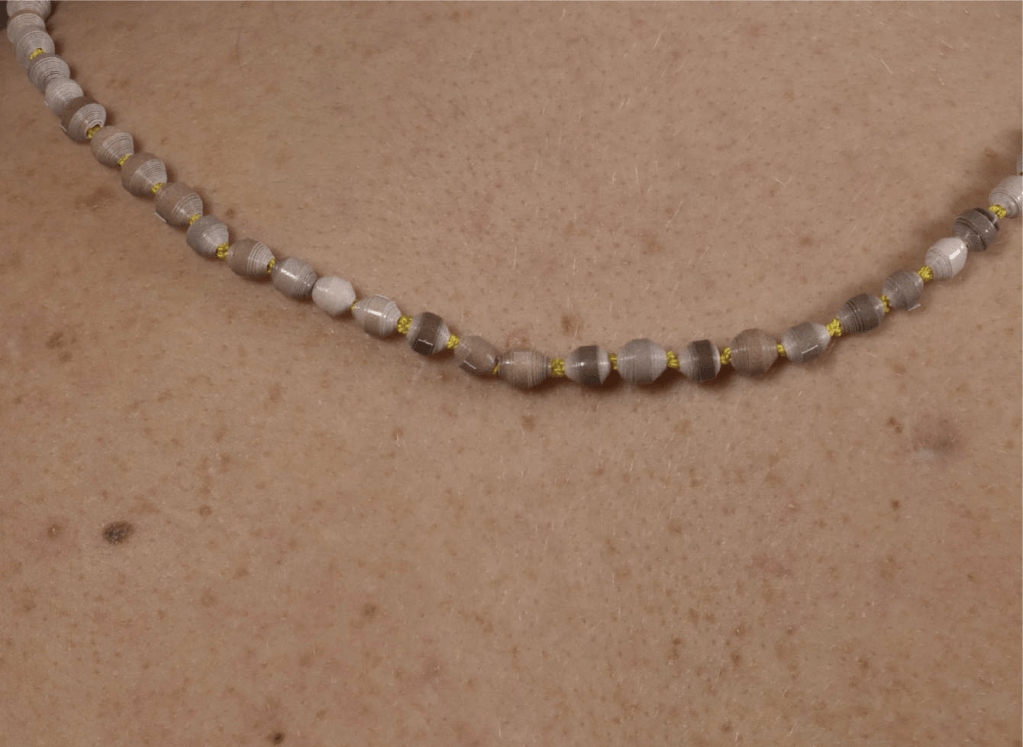
Anke Huyben’s Pearl Necklace subverts expectations of classical adornment by embedding the artist’s own fragmented body into a wearable object. Strung on yellow thread, the necklace consists of individually rolled beads formed from vinyl prints of the artist’s nude form including vulnerable poses, skin, and intimate gestures reduced to narrow vertical strips. When worn, as seen in the image, the piece rests intimately against the skin, its muted palette of greys, beiges, and skin tones blending with the wearer’s body while the bright yellow threading provides subtle visual punctuation.
The necklace achieves a remarkable balance of abstraction and tactility. Each bead, created by cutting and tightly rolling photographic prints, presents a smooth, cylindrical surface with faint horizontal banding that reveals slivers of the original images upon close inspection. The repetitive yet varied forms create a rhythmic sequence along the strand, their slight irregularities and tonal shifts preventing uniformity. The flexible structure drapes naturally across the collarbone, activating with the body’s movement and distributing visual weight evenly. This material transformation of photographic paper into luminous, pearl-like beads exemplifies Huyben’s method of enlarging, fragmenting, and recontextualizing the body through mixed media, reducing it to an abstracted yet deeply personal field.
Symbolically, the work functions as a layered meditation on objectification, transformation, and self-representation. Drawing on her experiences as a woman and jewelry designer, Huyben critiques the reduction of the female body to consumable fractions while acknowledging the complex power dynamics inherent in being seen. The pearl necklace, traditionally a symbol of purity and the transition from girlhood to womanhood, is here infused with the artist’s own vulnerable self-portraits. The beads conceal as much as they reveal. The viewer is given only partial glimpses of skin, gestures, or features that are visible, mirroring how individuals are often perceived through limited, externally imposed lenses. This fragmentation comments on sexual objectification and the passive aggression of the gaze, yet it also asserts agency—the artist reclaims and reconfigures her image on her own terms.
Huyben refuses binary interpretations of power. The necklace embodies both submission to the decorative tradition and a quiet assertion of the female body’s strength and desirability. By wearing these abstracted fragments of herself, the wearer participates in a dialogue about adoration, vulnerability, and control. The piece thus extends beyond decoration to become a critical object that interrogates jewelry’s fundamental relationship to the body: without the body, there is no jewelry; with it, adornment becomes a site of ongoing negotiation.
Sources
Huyben, A. (n.d.). Anke Huyben [Artist website]. Retrieved May 24, 2026, from https://cargocollective.com/ankehuyben
Mason, V. (2025, July 12). Connecting through the body: In conversation with The Body Collective. Art Jewelry Forum. Retrieved May 24, 2026, from https://artjewelryforum.org/interviews/connecting-through-the-body_in-convo-with-the-boy-collective_anke-huyben_katja-prins_chequita-nahar_auth-vicki-mason_authnatl-australia_12-7-2025_/
Not Real Art. (n.d.). Q+Art: Jewelry designer Anke Huyben highlights the body underneath the decoration [Interview]. Retrieved May 24, 2026, from https://notrealart.com/jewelry-designer-anke-huyben-human-body-decoration/
 Eating Diamonds
Leave a comment