
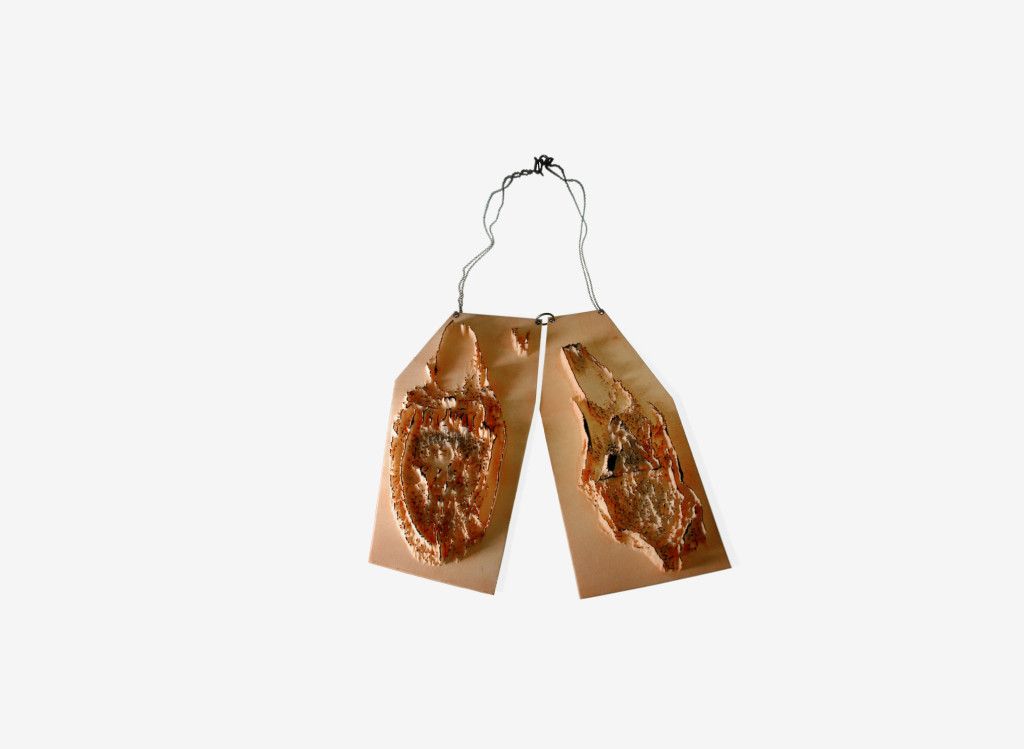
The two plaques hang there, slightly apart, joined only by a thin silver chain connected at the top. Coppery-orange, matte, irregular. The left one is denser, a little wider, its surface ridged and fibrous like something that has been compressed and then worn down. The right one opens up, more excavated, the texture pulling away from the center as if material has been removed rather than added. The edges are not clean. They look bitten, eroded, unfinished on purpose. Light catches the raised parts and sinks into the recesses. From a distance, they could almost be wood or bone. Up close, they read as metal worked by both machine and hand.
Physically, the piece is both bold and quiet. Minimal shine, no stones, no clever clasp. Just two related but non-identical forms suspended so they can move a little against the body. The chain is provisional, almost temporary. Everything about the construction refuses preciousness. What remains is the record of process: the travel paths of the CNC tool made visible, the calculated routes, and the unavoidable idle distances turned into topography. The surfaces are maps of time spent cutting and time spent moving between cuts.
That visibility matters. Most industrial making hides its own itinerary. Here, the itinerary becomes the object. The dual form feels important too—one denser, one more voided—like stages of the same operation or like positive and negative held in permanent proximity. They don’t resolve into a single statement. They stay in relation. The piece carries the tension between efficiency and residue, between the programmed path and the hand that later refined it. It also carries the older questions that run through Beate Eismann’s Printed Matter series: original and copy, prototype and reproduction, what gets kept and what gets discarded in the act of making.
CNC routing is a subtractive process. A computer-guided tool removes material from a solid block according to a path calculated in advance. What is left is not something built up but the shape that remains after removal. In this necklace, the two large plaques are exactly that residue.
Hung against the chest on a thin silver chain, they place the evidence of every cut directly on the body. You wear the path of the piece’s own creation. The plaques rest, shift slightly with movement, and keep their awkward distance from each other. Nothing is hidden. The time the machine spent and the decisions that shaped every ridge remain present. That presence is the meaning: the simple, stubborn fact of a subtractive process made wearable.
References
Art Aurea. “Beate Eismann.” Accessed August 18, 2026.
https://artaurea.com/profiles/eismann-beate/
Art Aurea. “Future Form – Art Jewellery with new Technologies.” Accessed August 18, 2026.
https://artaurea.de/2018/future-form/
Klimt02. “Beate Eismann: Bracelets in 3D Print.” Accessed August 18, 2026.
https://klimt02.net/events/exhibitions/21948
Museum für Angewandte Kunst Köln. “Kleine Faltung in Titan.” Accessed August 18, 2026.
https://nat.museum-digital.de/objects?&s=persinst%3A40481
 Eating Diamonds
Leave a comment