
Philip Sajet’s, Shard, is a ring that resists comfort visually, materially, and symbolically. It announces itself not as adornment in the traditional sense, but as an interruption. The object feels closer to a fragment pulled from an accident site than a jewel intended for the body. This tension is deliberate, and it is where the work is most successful.
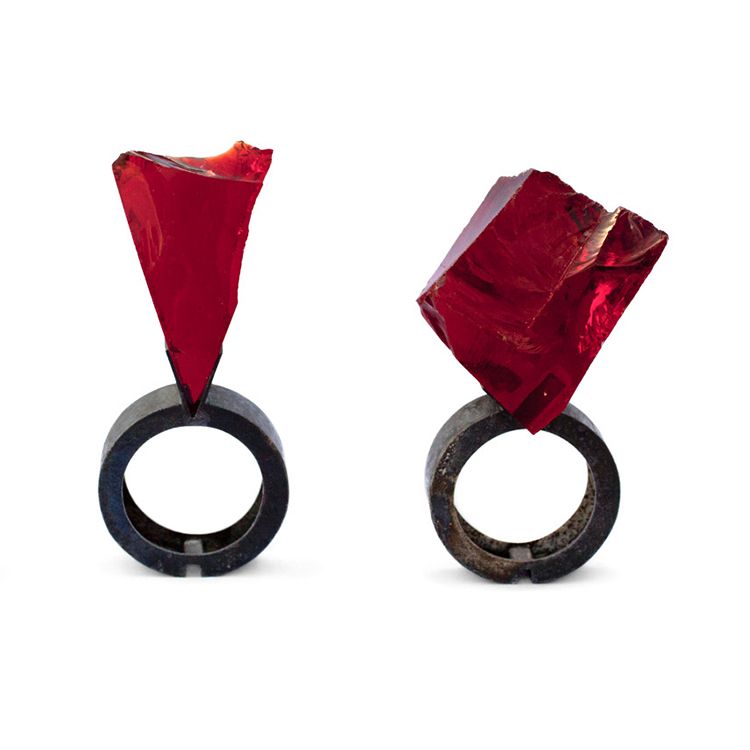
Materials: niello on silver, glass
Photo: Beate Klockmann
Technically, Shard is deceptively rigorous. The glass element is not softened, rounded, or domesticated. It remains visibly fractured, retaining the violence of its break. This is not faux-rawness; glass is notoriously unforgiving, and its use here signals confidence and control. The nielloed silver ring shank is heavy, darkened, and resolutely industrial. Niello, historically associated with fine detail and ornament, is here used to suppress luster rather than enhance it. Sajet denies the viewer the easy pleasure of shine. Instead, the surface absorbs light, allowing the glass shard to dominate visually and conceptually.
The relationship between the glass and the ring is critical. The shard does not sit on the ring in a decorative sense; it appears impaled, embedded, or forcibly fixed. The orientation of the glass—upright in one instance, canted in the other—suggests instability. This is jewelry that refuses equilibrium. While symmetry and harmonious proportion are often associated with beauty, Sajet knowingly disrupts them. The proportions feel intentionally wrong: the glass is too tall, too sharp, too aggressive for the finger. Yet the imbalance is precise. The work demonstrates a seasoned understanding of when to break formal rules and how far to push without collapsing into chaos.
Symbolically, Shard operates in the space between preciousness and threat. Glass, unlike gemstones, carries no intrinsic value in the traditional hierarchy of materials. Its worth here is experiential rather than monetary. Red glass, in particular, evokes blood, warning, and heat, which signals the body reads instinctively. Worn on the hand, the shard becomes a public declaration of vulnerability and danger. It suggests injury without depicting it directly.
There is also humor in Shard, though it is dry and understated. The absurdity of placing something so apparently dangerous on a finger cannot be ignored. Jewelry is traditionally associated with intimacy, safety, and sentiment. Sajet subverts this by introducing an element that feels fundamentally incompatible with daily life. You do not forget you are wearing this ring. It refuses to disappear into habit. Critically, one could argue that Shard prioritizes concept over wearability to an extreme degree. This is not a flaw so much as a boundary. The ring functions more convincingly as a sculptural proposition than as functional jewelry. Its success depends on whether one accepts jewelry as a site for confrontation rather than comfort.
It embodies the confidence of an artist who understands that technical mastery is not about refinement alone, but about knowing when to leave the edge sharp. The ring does not ask to be liked. It asks to be reckoned with. Sajet has long been interested in redefining beauty, and Shard sits firmly within that inquiry. Beauty here is not smooth, balanced, or reassuring. It is tense and unresolved. The ring asks the wearer and the viewer to tolerate discomfort, to reconsider what qualifies as adornment. In this way, Shard aligns with Sajet’s broader pedagogical philosophy: being “sure about your unsureness.” The piece does not seek consensus. It does not explain itself. It trusts its own logic. Ultimately, Shard is a work about control of material, of fear, of beauty itself.
References
Galerie Door. “Philip Sajet.” Accessed September 4, 2025.
https://www.galeriedoor.nl/artist/philip-sajet/
Mathilde Gallery. “Philip Sajet.” Accessed September 4, 2025.
https://mathildegallery.com/artist-phillip-sajet/
Klimt02. “Philip Sajet.” Accessed September 4, 2025.
https://klimt02.net/jewellers/philip-sajet
Wytwórnia Antidotum. “Philip Sajet on the Art of Jewellery.” Accessed September 4, 2025.
https://wytwornia.antidotum.pl/en/philip-sajet-about-the-art-of-jewellery/

 Eating Diamonds
Leave a comment