
The necklace Sugar and Spice (2023) by Mary Hallam Pearse is structured as an accumulation of interlocking forms that refuse a single point of orientation. The piece extends laterally across the collar bone, distributing weight and attention evenly directing it toward a central element, the bow. Its composition is continuous, with each segment feeding into the next, creating a chain structure that reads less as a sequence and more as a dense, uninterrupted field.
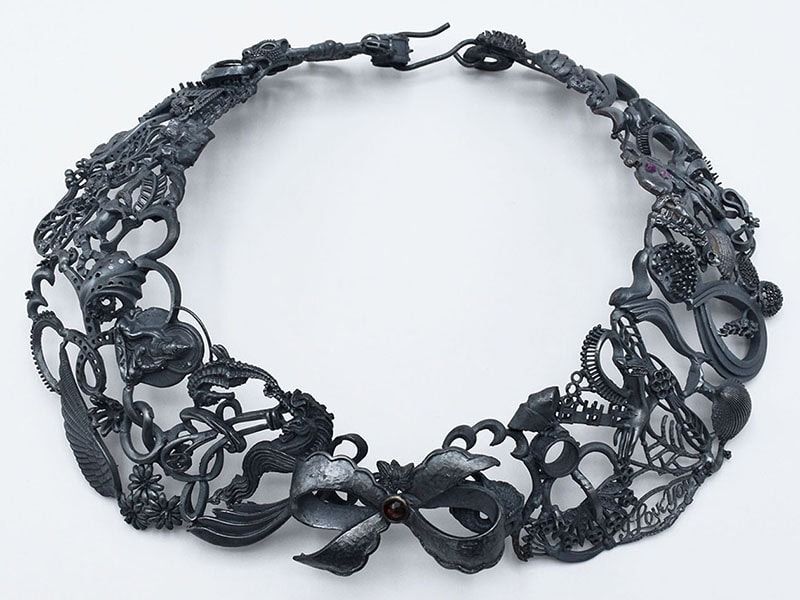
The surface is materially restrained but formally excessive. The oxidized sterling silver absorbs light, reducing reflectivity and emphasizing contour and silhouette. This treatment suppresses any sense of polish or refinement typically associated with jewelry, allowing the complexity of the structure to dominate. A single garnet is embedded as a focal point and a minor disruption within the network. The presence registers as punctuation of ornament.
What emerges is a system of relations rather than a collection of parts. Organic references such as floral and animal-like forms are entangled with mechanical elements, including loops, gears, and structural connectors. These categories are not separated but fused, producing a hybrid language where distinctions between natural growth and constructed assembly collapse. The object appears to have developed through accumulation, as if each element was added in response to the last, resulting in a structure that feels both intentional and unstable.
A further layer of meaning emerges through the logic of excess that structures the piece. The accumulation of parts is not simply decorative but operates as a method of resistance against clarity and singular interpretation. Each element introduces its own referential weight, yet none are allowed to stabilize into dominance. This produces a condition where meaning is continually deferred, distributed across the surface rather than contained within any one motif. The necklace becomes a site of ongoing negotiation, where associations of ornament, utility, and symbolism circulate without resolution.
This excess also reframes the relationship between labor and value. The density of detail signals an intensive investment of time and attention, yet the oxidized finish and compression of forms obscure the legibility of that labor. What might traditionally be highlighted as craftsmanship is instead embedded within a field that resists easy appreciation. In this way, the work complicates expectations of both adornment and skill, positioning itself within a space where visibility, meaning, and value are deliberately unsettled.
The title operates as a point of friction. “Sugar and Spice” invokes a culturally familiar construction of femininity tied to sweetness and ease. The necklace counters this directly through density, weight, and visual saturation. Its complexity resists legibility at a glance, requiring sustained attention to navigate its surface. Rather than presenting femininity as cohesive or decorative, the work proposes it as layered, excessive, and difficult to resolve.
A further layer of meaning emerges through the logic of excess that structures the piece. The accumulation of parts is not simply decorative but operates as a method of resistance against clarity and singular interpretation. Each element introduces its own referential weight, yet none are allowed to stabilize into dominance. This produces a condition where meaning is continually deferred, distributed across the surface rather than contained within any one motif. The necklace becomes a site of ongoing negotiation, where associations of ornament, utility, and symbolism circulate without resolution.
This excess also reframes the relationship between labor and value. The density of detail signals an intensive investment of time and attention, yet the oxidized finish and compression of forms obscure the legibility of that labor. What might traditionally be highlighted as craftsmanship is instead embedded within a field that resists easy appreciation. In this way, the work complicates expectations of both adornment and skill, positioning itself within a space where visibility, meaning, and value are deliberately unsettled.
Worn on the body, the piece does not settle into the role of passive adornment. It asserts itself as a presence that interrupts the surface it occupies. The necklace frames the neck while simultaneously overwhelming it, shifting the relationship between wearer and object. Meaning is produced through this imbalance, where accumulation becomes a strategy for complicating expectation and destabilizing familiar readings of jewelry and identity.
Sources
University of Georgia Lamar Dodd School of Art. (n.d.). Mary Hallam Pearse [Faculty profile]. Retrieved March 20, 2026, from https://art.uga.edu/profile/mary-hallam-pearse/
Stove Works. (n.d.). MHP [Artist page]. Retrieved March 20, 2026, from https://www.stoveworks.org
Smithsonian American Art Museum. (n.d.). Mary Hallam Pearse [Artist profile]. Retrieved March 20, 2026, from https://americanart.si.edu/artist/mary-hallam-pearse-33898
Voyage ATL Magazine. (2019). Meet Mary Hallam Pearse [Interview]. Retrieved March 20, 2026, from https://voyageatl.com/interview/meet-mary-hallam-pearse/
The Red & Black. (2025). Athenians to know: Mary Hallam Pearse [Article]. Retrieved March 20, 2026, from https://www.redandblack.com/guides/athens/athenians-to-know-mary-hallam-pearse/article_799ead00-f544-11ef-9042-2b24f84451a5.html
Art Jewelry Forum. (n.d.). Mary Hallam Pearse [Object feature]. Retrieved March 20, 2026, from https://artjewelryforum.org/object-features/mary-hallam-pearse/
ATHICA. (n.d.). Onodera & Pearse: Contrasts and Correlations [Exhibition page]. Retrieved March 20, 2026, from https://athica.org/updates/onodera_pearse/
 Eating Diamonds
Leave a comment