
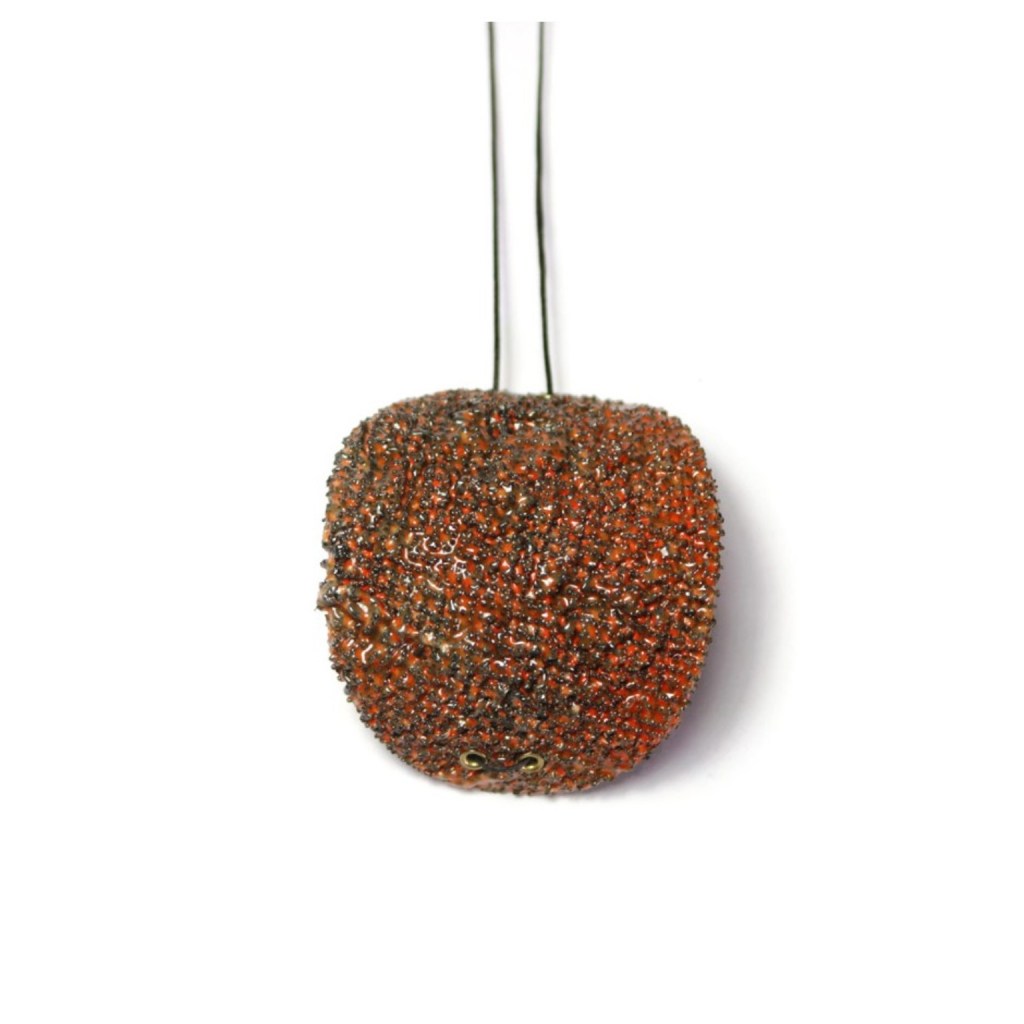
The necklace, Sundown (2018), by Nassrin Vessalian, presents itself as a dense, compact form, its scale intimate yet materially expansive. The object is roughly cubic, its softened edges resisting strict geometry while maintaining a sense of containment. Suspended from a thin cord, the piece appears both weighted and precarious, as if the mass it carries exceeds what the structure conventionally supports.
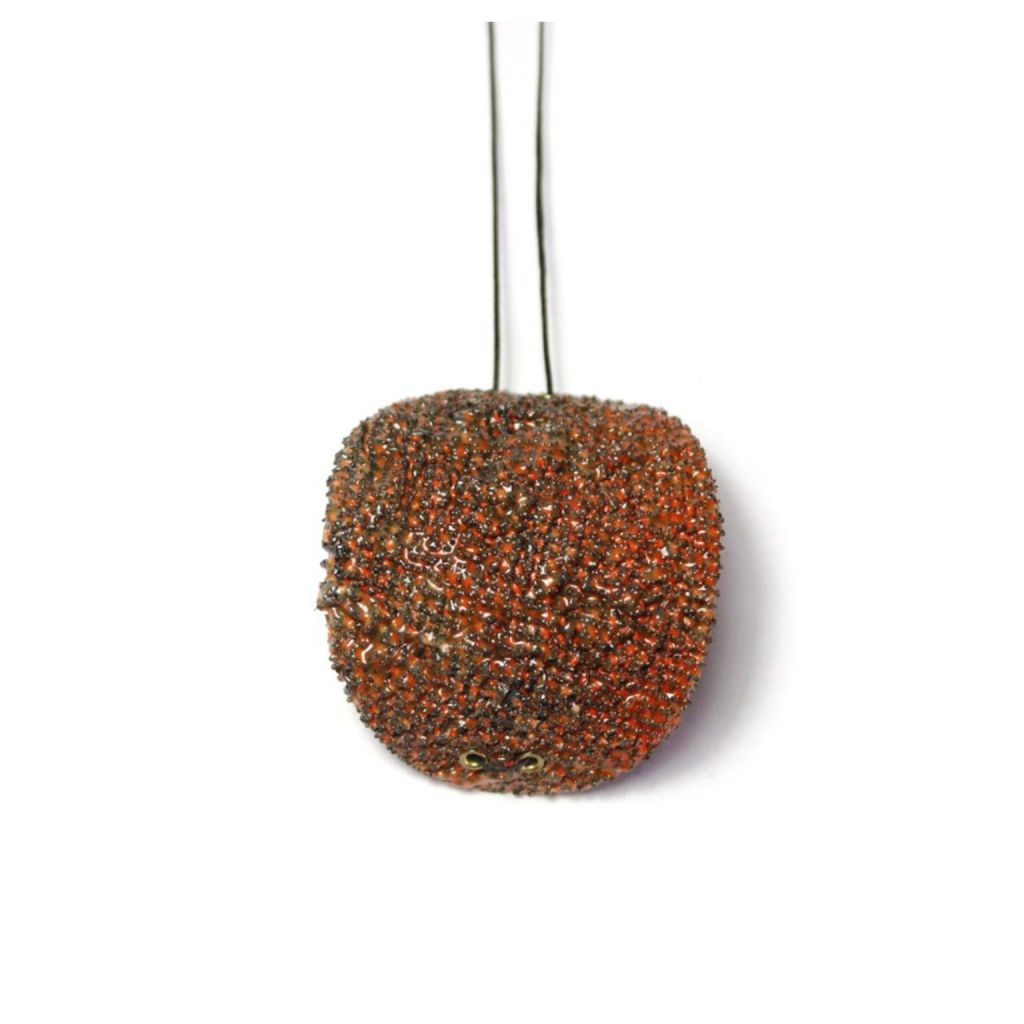
Its surface is the primary site of formal articulation. Composed of latex, acrylic, and resin, the exterior accumulates into a granular, almost encrusted skin. Countless small protrusions gather across the surface, producing a tactile field that oscillates between organic growth and synthetic aggregation. The coloration, a deep, mottled red with darker inflections, evokes a state of saturation. Light does not move smoothly across it but becomes caught in the irregularities, emphasizing depth and unevennessThis surface resists refinement. It denies the polished finish typically associated with jewelry, instead foregrounding process, accretion, and material instability. The handmade composite suggests a prolonged duration of making, where substances are allowed to interact, harden, and settle into unpredictable configurations. The object reads as something that has formed rather than something that has been cleanly constructed.
The title Sundown introduces a temporal and symbolic dimension. It suggests a moment of transition, the collapse of light into darkness, or the threshold between activity and stillness. This is not represented through imagery but through material condition. The darkened reds and dense surface imply a state of compression, as if the object holds within it the residue of a process that has reached its limit.
At the level of the body, the necklace complicates expectations of adornment. Its texture appears abrasive, even hostile to touch, positioning the wearer in a relation that is not purely aesthetic but confrontational. The piece does not enhance the body’s surface but interrupts it. In doing so, it aligns with a critique of jewelry as luxury object. The materials, which evoke the discarded or the non-precious, challenge conventional hierarchies of value while reconfiguring what it means for an object to be worn. Form and symbolism converge through accumulation and resistance. The compact volume contains an excess of surface activity, while the surface itself suggests processes of decay, growth, or coagulation. Meaning emerges through this tension. The work does not resolve into a singular reading but remains in a state of material and conceptual density, where time, value, and bodily relation are held in suspension.
References
Nassrin Vessalian. (n.d.). Nassrin Vessalian [Artist page]. Retrieved March 9, 2026, from https://www.no-gram.com/226-nassrin-vessalian
Tamagit. (n.d.). Sundown I brooch object Nassrin Vessalian [Gallery page]. Retrieved March 9, 2026, from https://tamagit.com/art-gallery/sundown-i-brooch-object-nassrin-vessalian/
 Eating Diamonds
Leave a comment