
There is a particular kind of beauty that doesn’t ask for approval. It doesn’t shimmer prettily under gallery lighting or offer itself up as ornament in any conventional sense. Instead, it insists on its own terms, through its own logic that you come closer, look harder, and reconsider what you thought you understood about nature, craft, and the objects we choose to put on our bodies. Terhi Tolvanen’s Curly Rust (2022) is exactly this kind of work.
At 55 millimeters in length, these earrings occupy the precise space between jewelry and miniature sculpture. Tolvanen, the Finnish artist who has lived and worked in France for many years and whose work is held in the permanent collections of the Victoria & Albert Museum, the Rijksmuseum, and the Musée des Arts Décoratifs, has always operated in this productive in-between zone. But, Curly Rust feels particularly charged as it’s a distillation of everything her practice has been moving toward. The materials do most of the talking: opal, grape wood, composite, and silver. Each is chosen for what it contributes structurally and conceptually to the whole. The opal, a mercurial of gemstones, plays against the grape wood in a way that shouldn’t work but does. Wood is warm, fibrous, biological, finite. It decays. Opal, by contrast, seems to generate light from within, shifting and alive in a way that reads as almost supernatural. Together, they create a dialogue between the organic and the luminous, between things that fade and things that seem to hold time differently.
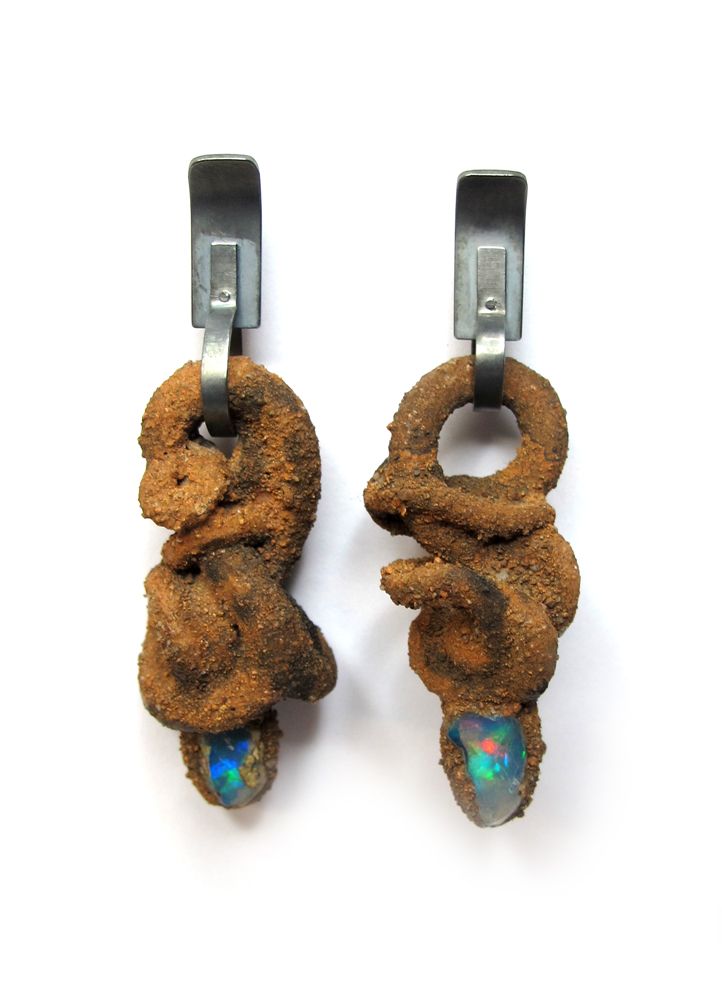
Earrings
Materials: opal, grape wood, composite, silver
The title points you toward texture before you even see the piece. “Curly” suggests movement, something mid-unfurl, caught in process. “Rust” introduces decay, oxidation, the beautiful evidence of time acting on material. The grape wood, with its particular grain and the associations it carries through vineyards, cultivation, seasonal cycles, the transformation of raw fruit into something fermented and complex, amplifies this reading. This is wood that has been somewhere and done something. It carries a life before its life as jewelry. The composite elements hold everything together in a way that is characteristic of Tolvanen’s work: practical, inventive, unconcerned with material purity. The silver, used sparingly, anchors the whole without dominating.
Tolvanen’s work is genuinely topographic. She builds environments at the scale of the body, places where natural forces play out in miniature. Curly Rust is a landscape of transformation. Rust is not damage in this contex but is information. It tells you how long something has been in the world, what it has been exposed to, what forces have worked on it. The piece also engages with what Tolvanen calls “element thinking”: a construction method that preserves freedom almost to the end of the making process. Rather than working from a fixed blueprint, she builds through accumulation, through an ongoing dialogue between materials and hands. You can feel this in Curly Rust. It does not look designed so much as arrived at. The curling form seems to have happened, the way rust happens, the way wood grain happens.
There is something quietly radical about this in the context of contemporary jewelry, which so often prioritizes the precious and the permanent. Tolvanen introduces temporality as a value. The grape wood will continue to age. The opal will catch different light on different days. The piece is not static.
To wear Curly Rust is to carry a small argument against the glossy and the immaculate. It says something about valuing the weathered, the naturally complex, the thing that shows its history. There is also something intimate about wood against skin. Unlike metal, which stays cool, wood breathes. It is porous, responsive, alive in a way that more conventional jewelry materials are not. Choosing to wear it is a commitment to that aliveness. Tolvanen’s work, at its best, asks the wearer to participate in its meaning, to be the living landscape on which these small environments rest. Curly Rust does this with particular grace.
References
Humoring the Goddess. (n.d.). Terhi Tolvanen [Blog posts]. Retrieved February 12, 2026, from https://humoringthegoddess.com/tag/terhi-tolvanen/
Jewellery Notes. (2009). Jewel designer ID: Terhi Tolvanen. Retrieved February 12, 2026, from https://www.jewellerynotes.com/2009/jewel-designer-id/teri-tolvanen
Musée des Arts Décoratifs. (n.d.). Terhi Tolvanen: Collier Curly, 2016. Retrieved February 12, 2026, from https://madparis.fr/Terhi-Tolvanen-Collier-Curly-2016
Current Obsession. (n.d.). Sophie Hanagarth [Article referencing Terhi Tolvanen]. Retrieved February 12, 2026, from https://current-obsession.com/sophie-hanagarth/
Artsy. (n.d.). Terhi Tolvanen. Retrieved February 12, 2026, from https://www.artsy.net/artist/terhi-tolvanen
Tolvanen, T. (n.d.). Terhi Tolvanen [Artist website]. Retrieved February 12, 2026, from https://www.terhitolvanen.com/
 Eating Diamonds
Leave a comment