
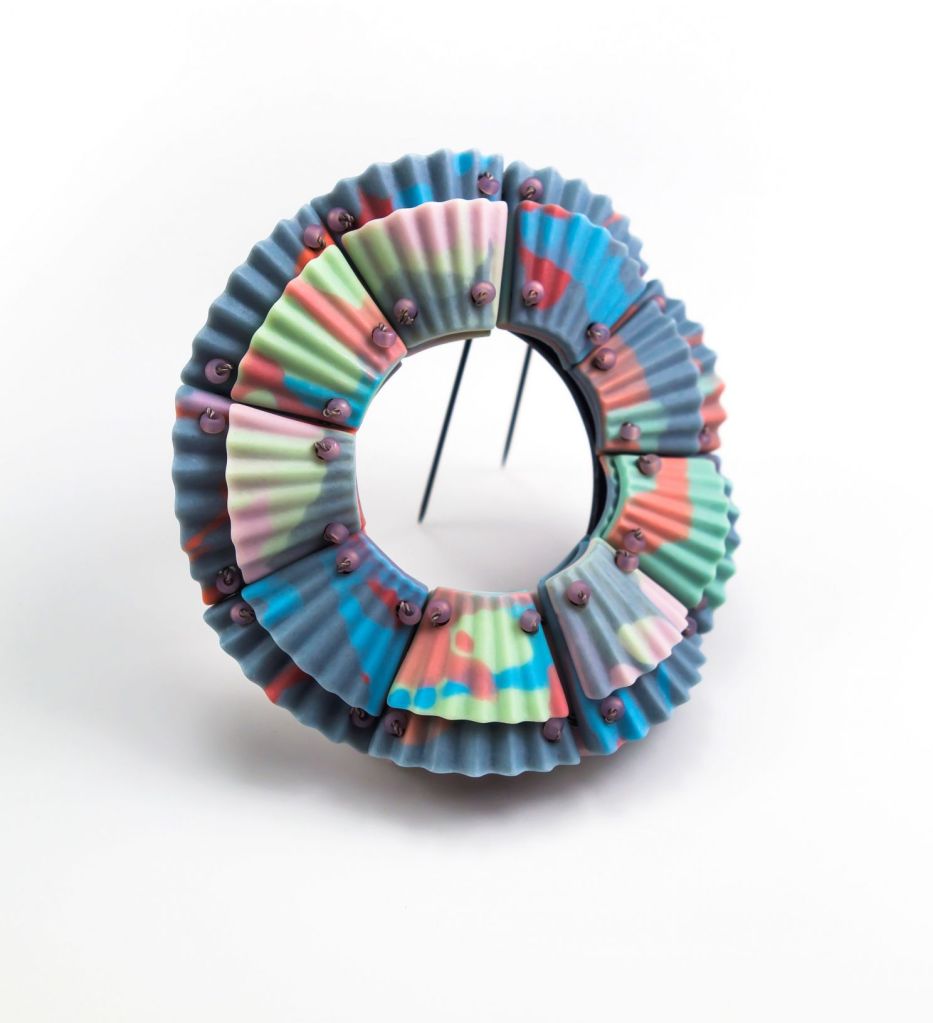
Brooch
Materials: Mont-Blanc porcelain, pigment, beads, thread, silver, steel
Mia Kwon’s Balance brooch is constructed from Mont-Blanc porcelain, slip cast into repeated pleated segments that are later assembled into a complete circular form. Each fluted module is individually shaped, pigmented, fired, and polished to a slick, almost lacquered surface. The units are then sewn together with thread and reinforced with silver and steel findings. Small beads are applied across the ridges, interrupting the rhythm of the folds and adding moments of tension. Though porcelain is traditionally associated with brittleness, Kwon’s technical control allows the elements to feel improbably light and textile-like.
The circle is precise, six centimeters in diameter, yet it reads as expansive because of its radiating pleats. The color transitions are layered rather than flat, suggesting multiple firings or controlled pigment applications. Blue dissolves into coral; mint into pink. The palette feels intentional but not rigid, as if the surface holds evidence of process. Sewing becomes both structural and visible. It is not disguised. Instead, it acknowledges assembly as an act of care and construction.
Symbolically, the circular form carries weight. A ring suggests continuity, repetition, and containment. The pleated units introduce movement into that stability. They resemble paper filters, fabric ruffles, or ceremonial collars. These are objects tied to domesticity and adornment. Porcelain, long linked to refinement and fragility, is here mobilized into something active. The beads punctuating the folds feel almost like pins or markers, emphasizing points of connection. Nothing is seamless. Everything is held in place through tension.
The title Balance suggests equilibrium, but the brooch proposes something more nuanced. It is not a perfect symmetry; it is a managed instability. Hard material mimics softness. Structural sewing mimics ornament. Industrial slip casting meets intimate hand assembly. Worn on the body, the circle frames space, becoming both object and aperture. Kwon’s work shifts porcelain away from static decoration and toward the relational form of an object that negotiates control and delicacy, repetition, variation, restraint, and expression.
References
Museum of Arts and Design (MAD). “Mia Kwon.” Accessed January 27, 2026.
https://madmuseum.org/jewelry/artist/mia-kwon
Mia Kwon. “Info.” Accessed January 27, 2026.
https://bymia.org/info.html
Amaranto Joies. “Mia Kwon.” Accessed January 27, 2026.
https://amarantojoies.com
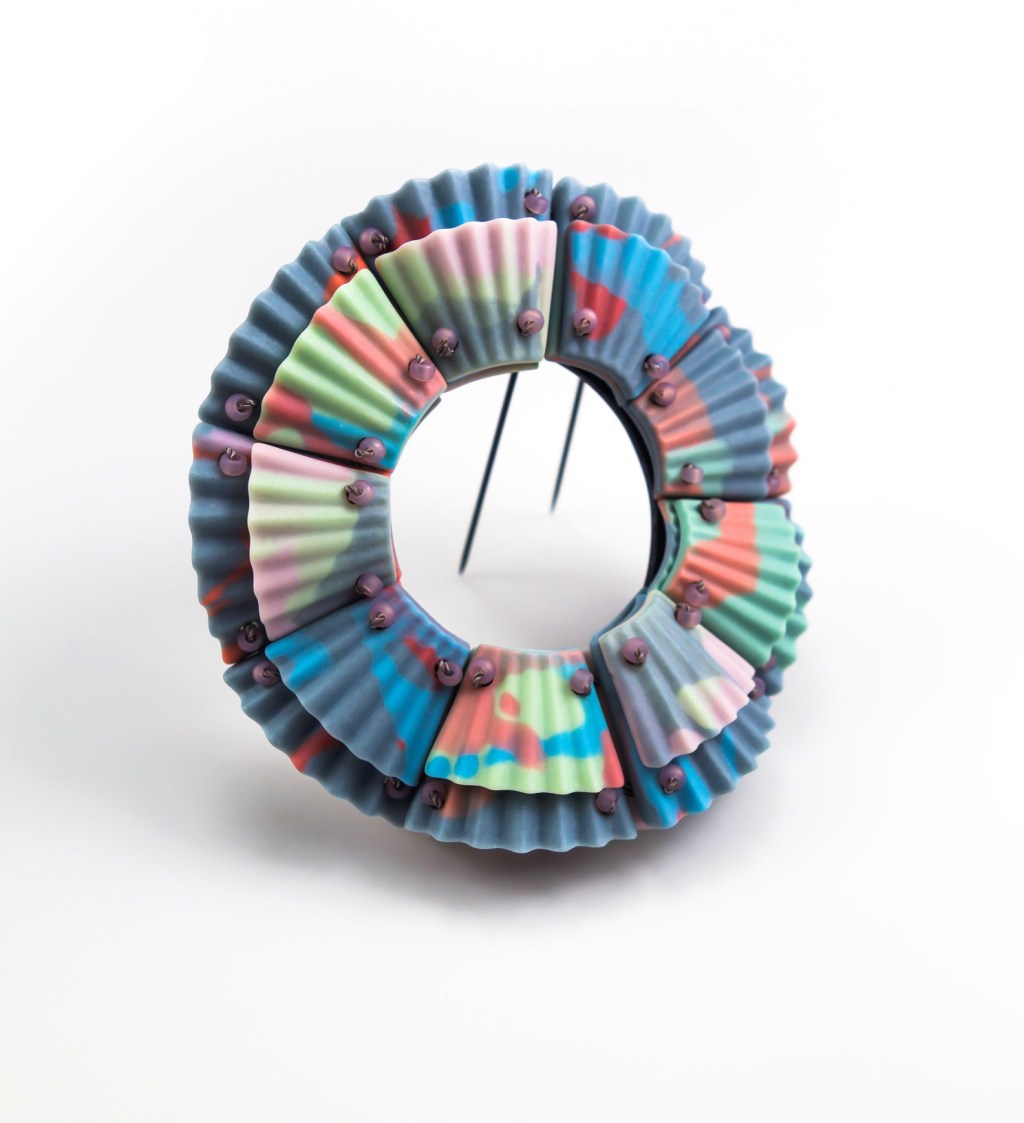
 Eating Diamonds
Leave a comment