
At first glance, Gijs Bakker’s Frank de Boer brooch reads like a cut-out image caught mid-motion. A frozen athlete suspended in a high kick. The figure is printed in a warm, sepia-toned palette, as if lifted from an old newspaper photograph and preserved just long enough to become collectible. The pose is dramatic, but the object itself is weightless in feeling: flat, thin, and quiet.
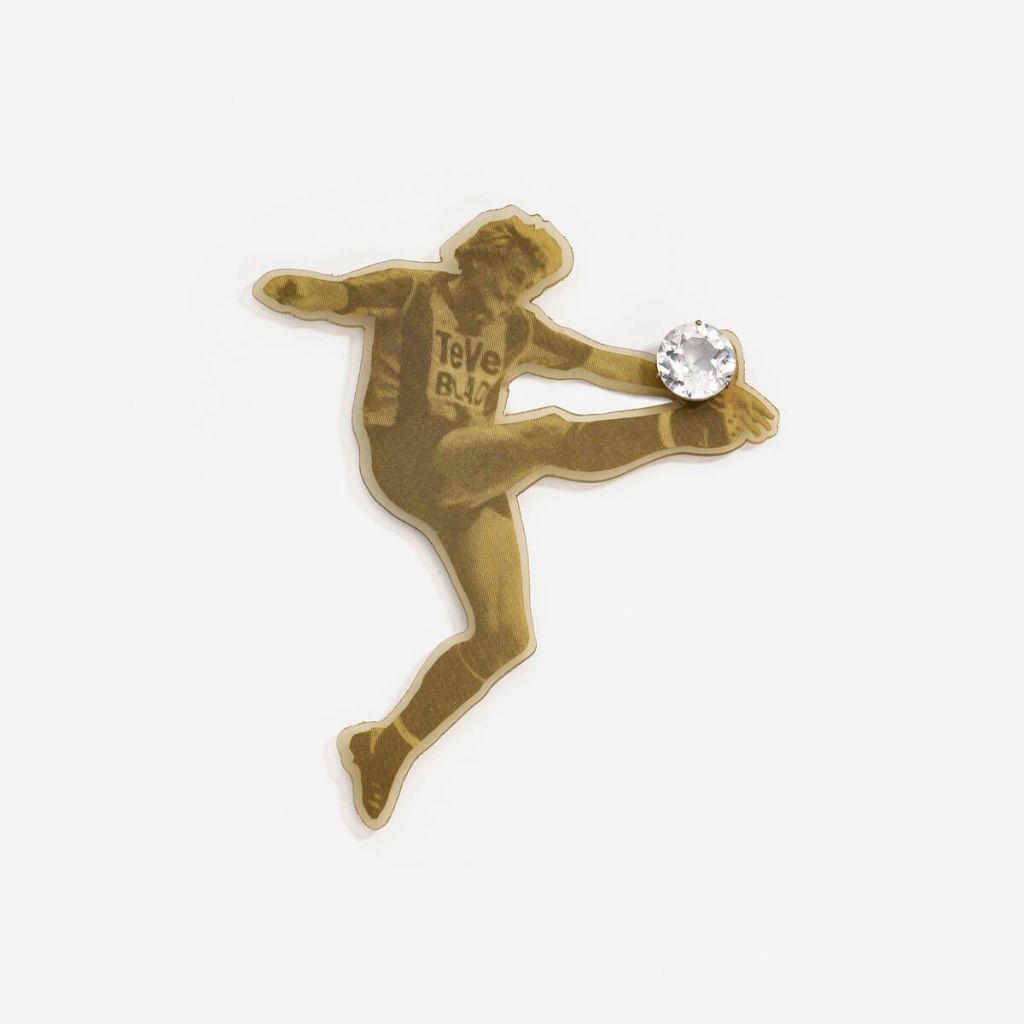
This brooch is built on a silhouette. A single athletic figure is caught mid–high kick, flattened into a crisp cut-out and held in place as an image rather than a body. The pose carries athletic strain of an extended leg, open arms, and a torso that tilts for balance. But, the work refuses volume. It is all surface. The piece is not sculpted so much as extracted. The material language reinforces that thinness. Newspaper and PVC create a sense of lightness and immediacy, like something meant to circulate rather than endure. The printed image feels intentionally low-stakes: familiar, everyday, and already mediated. It reads as documentation first and object second.
The only element that breaks the logic of “image” is the stone. A white, faceted gem is positioned near the foot, where the gesture of impact is implied. It becomes the brightest and most concentrated point in the composition, acting like an anchor. The brooch doesn’t build meaning through accumulation; it builds it through interruption. The stone punctures the picture. Formally, it’s a simple move, but it changes the entire register of the work. The brooch becomes a collision between two systems: the quickness of media and the permanence jewelry is supposed to claim. The athlete is already a public image and an icon produced through repetition, consumption, and recognition. Bakker doesn’t transform that into something sacred. He keeps it exactly as it is: flat, reproduced, and available. That choice feels deliberate. This isn’t a portrait made to honor a person. It’s a portrait made to expose how easily a person becomes a symbol. A sports figure is a body trained into spectacle through discipline, observation, and performance. In this work, that body becomes even more abstract: a sign that can be pinned to someone else.
The gemstone complicates that further. Jewelry typically uses stones to confirm value. Here, the stone reads less like preciousness and more like a critique of preciousness. It’s almost too on-the-nose because it’s placed in a way that feels unromantic, like a label. This is the “jewel” part. This is what you came for. The use of synthetic spinel matters. It gives the shimmer of wealth without the mythology of rarity. It performs luxury while quietly refusing its most familiar story. The brooch doesn’t argue against decoration but instead shows how decoration works. It shows how quickly value can be attached to anything, as long as it sparkles. This is where Bakker’s restraint becomes sharp. The piece doesn’t demand emotional intimacy. It doesn’t lean on craftsmanship to persuade you. It stays clean, direct, and slightly distant. The distance is the point. The brooch doesn’t want you to fall in love with the object as much as it wants you to notice the mechanism: image + gem = desirability.
What I find most effective here is how little the work needs to do to shift the meaning of jewelry. The brooch is not heavy-handed. It’s not dramatic. It’s light, almost casual. And that casualness is what makes it unsettling. It mirrors the way we already consume bodies, images, status, and beauty without thinking too hard about it.
Bakker’s Frank de Boer brooch feels less like a celebration of sport and more like a small lesson in how contemporary jewelry can behave and how it can borrow from mass media, refuse romance, and still function perfectly as adornment. It sits right on the edge of charm and critique, which is where Bakker has always been strongest.
References
Wright. “Gijs Bakker: Frank de Boer Brooch (from the Sports Figures series).” Accessed January 18, 2026.
https://www.wright20.com/auctions/2024/09/contemporary-design/179
Gijs Bakker. “About Gijs Bakker.” Accessed January 18, 2026.
https://gijsbakker.com/about-gijs-bakker
Louis Kalff Institute. “Gijs Bakker.” Accessed January 18, 2026.
https://www.louiskalffinstituut.nl/en/gijs-bakker-2/
Art Jewelry Forum. Tergau, James. “Gijs Bakker on Shuttering Chp…? 23 Years of Both Design and Contemporary Jewelry.” Accessed January 18, 2026.
https://artjewelryforum.org/interviews/gijs-bakker-on-shuttering-chpae%C2%A6/
 Eating Diamonds
Leave a comment