
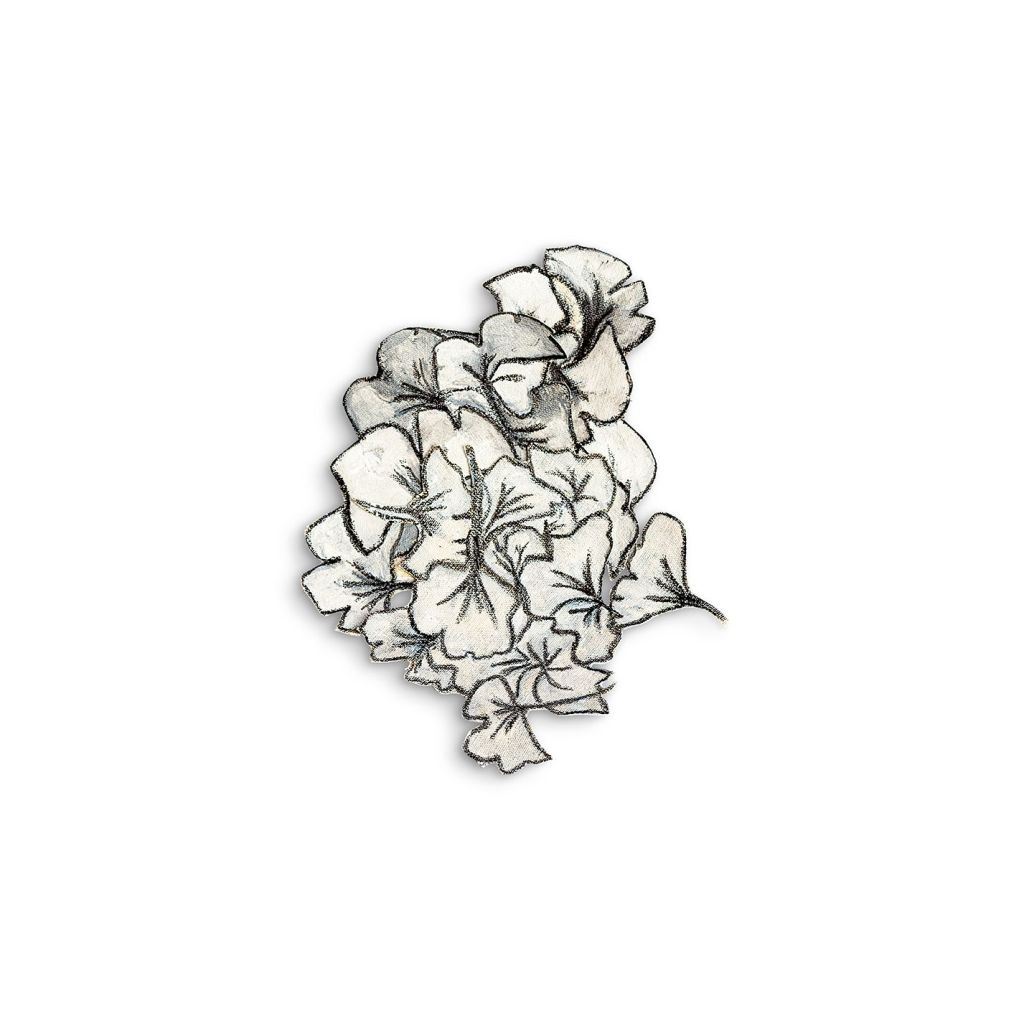
Brooch
Materials: canvas, charcoal, gesso, ink, copper, watercolor ground, sterling silver, stainless steel
Autumn Bouquet III presents itself as a small cluster of flowers, compressed into a tight silhouette and held just slightly off the surface like a cutout memory. It reads as soft and familiar at first glance, but the longer you look, the more the brooch reveals itself as something constructed through layering, edged composition, and deliberately controlled through balance. The bouquet is not loose or romantic. It’s shaped, stacked, and composed like a decision.
The formal structure is built through repetition: petal after petal, each outlined in charcoal with a quick, sketch-like pressure. The marks feel intimate and immediate, as if the drawing happened close to the body and stayed close. There’s a subtle tension between the natural subject and the way it’s rendered. Flowers typically imply fragrance, bloom, or abundance. Here, they feel slightly flattened. Less botanical and more like a botanical illustration that has been handled too much, and slowly softened by time. The palette is restrained, nearly monochrome. That limited range does something important: it makes the work feel archival rather than decorative. These flowers are not bright or celebratory, but they behave like an archival record. Even the edges have a kind of hush to them. The bouquet doesn’t announce itself; it stays contained.
The materials make the work sharper. Canvas, gesso, watercolor ground are painting materials. They bring the language of the studio and the page directly into jewelry, refusing the expectation that jewelry should be polished, reflective, or resolved through the shine of metal. The brooch asserts itself as an artwork first, but it doesn’t abandon wearability. It insists on both. The presence of copper and silver complicates the softness of the drawing. Those metals suggest structure, permanence, and the history of jewelry as an object meant to last. But here, the “lasting” is not romanticized. It feels protective, almost bracing, like the metals are there to hold a fragile image steady.
Symbolically, flowers are one of the most overused forms in adornment. They are easy to recognize and easy to consume. They can slip into prettiness without resistance. What makes Autumn Bouquet III successful is that it doesn’t use the bouquet as an ornament. Instead, it uses it as a container for attention. The flowers feel less like decoration and more like an emotional shorthand: a memory of something tender, pressed flat so it can be carried. There’s also something slightly uneasy about the bouquet’s density. It isn’t airy. It doesn’t drift. It crowds itself. The overlapping petals resemble accumulation, representing how memory builds when you return to the same image repeatedly, trying to preserve it without fully understanding why. Bessudo’s own language around the quotidian and “selective preserving” helps here: this is the kind of object that doesn’t document a grand event. It documents the smallness of lived experiences of what catches, what stays, and what refuses to disappear.
The brooch format matters. Pinning something to the body is intimate, but it’s also public. It turns a private attachment into an outward sign. Worn, Autumn Bouquet III doesn’t perform femininity in an obvious way. Instead, it performs a quieter ritual: holding something close that might otherwise be lost. It’s not a bouquet you give to someone else. It’s a bouquet you keep. This is where Bessudo’s work feels strongest: when it treats jewelry as a site of translation. Drawing becomes object. Painting becomes structure. A fleeting visual gesture becomes something you can carry. The materials don’t collapse into craft for craft’s sake; they act like a vocabulary. The surface holds evidence of process, and that process becomes part of the meaning.
Autumn Bouquet III isn’t trying to impress you with virtuosity. It’s doing something harder: it’s asking you to take softness seriously. Not as sweetness, not as decoration, but as a form of record-keeping. The brooch becomes a small proof that intimacy can be built intentionally, layer by layer, until it holds.
References
Bessudo, Raquel. “Biography.” Accessed December 5, 2025. https://raquelbessudo.com/
Museum of Arts and Design (MAD). “Raquel Bessudo.” Accessed December 5, 2025.
https://madmuseum.org/jewelry/artist/raquel-bessudo
Garland Magazine. “Raquel Bessudo ✿ An eloquent witness for the craft of the Mexican people.” Accessed December 5, 2025.
https://garlandmag.com/perennial/raquel-bessudo/
 Eating Diamonds
Leave a comment